

Every January, we hear the same thing:
New year, new habits.
We’re going to get organized. Keep the house cleaner. Stay ahead of the laundry. Stop letting shoes pile up by the door. Finally get everyone to help around the house.
But January isn’t the only opportunity for a fresh start.
For families with school-age children, the beginning of a new school year may be one of the most natural times of the year to establish better household habits and cleaning routines.
Think about it.
Bedtimes change. Morning routines change. Meal schedules change. Backpacks come back out. Sports and activities start up again. Everyone suddenly has somewhere to be at a certain time.
Your household is already adjusting to a new routine.
Why not use that opportunity to build a few better cleaning habits, too?
The Science Behind a “Fresh Start”

There’s actually research behind the idea.
Researchers Hengchen Dai, Katherine Milkman and Jason Riis studied what they call the “Fresh Start Effect.”
Their research, published in Management Science, found that people were more likely to pursue goals following meaningful points in time, which researchers call “temporal landmarks.”
Those landmarks included the beginning of a new week, month or year, birthdays, holidays and even the beginning of a new semester.
These moments can create a psychological dividing line between the past and the future. Instead of simply continuing yesterday’s routine, it feels like we’re beginning a new chapter.
That’s one reason January 1 feels like such a natural time to make a change.
But the beginning of a school year can provide another fresh start — especially for families.
And there’s another piece of habit research that’s important here.
Researchers studying habit change have found that our habits are often connected to the environments and circumstances around us. When those circumstances change, existing habits can become easier to disrupt and replace.
Back-to-school season changes a lot of those circumstances all at once.
In other words: your family’s routine is already changing. You might as well make the most of it.
Don’t Try to “Keep the House Clean”
That’s too big of a goal.
Instead, think about the handful of things that make your house feel messy.
Maybe it’s:
- Shoes piled by the door
- Backpacks covering the kitchen table
- Dirty dishes left around the house
- Toys in the family room
- Clothes on bedroom floors
- Crumbs underneath the kitchen table
- Pet hair accumulating on the carpet
- A kitchen counter covered in papers
- Bedrooms that never seem to get vacuumed
Pick two or three of your biggest trouble spots.
Then create small routines to deal with them.
The goal isn’t to suddenly become a family that keeps a perfectly clean house.
The goal is to make a few useful cleaning behaviors automatic.
Try the 10-Minute Family Reset

Here’s one of the simplest routines you can introduce:
Set a timer for 10 minutes every evening and have everyone help reset the house.
You might do it immediately after dinner, before the kids get screen time or right before everyone begins getting ready for bed.
During those 10 minutes:
- Put shoes away.
- Return backpacks to their designated spot.
- Pick up toys.
- Put dirty clothes in hampers.
- Clear off the kitchen table.
- Load the dishwasher.
- Wipe down the counters.
- Sweep the kitchen.
- Vacuum the family room.
- Get everything ready for tomorrow.
Ten minutes doesn’t sound like much.
But consider a family of four.
If four people each spend 10 minutes cleaning, that’s 40 minutes of combined household effort.
Do that five nights during the school week and your family has put in more than three hours of combined effort without anyone having to spend an entire Saturday cleaning the house.
More importantly, you’re building a repeatable routine.
Give the Routine a Trigger
“Remember to clean your room” isn’t much of a system.
A better approach is to connect a cleaning task to something that already happens every day.
For example:
After dinner → 10-minute family reset
After homework → backpack goes by the door
Before screen time → bedroom gets picked up
After brushing your teeth → dirty clothes go in the hamper
Before bed → toys get put away
Sunday evening → bedrooms get vacuumed
These existing activities become reminders for the new behavior.
Over time, you want “after dinner” to automatically mean “time to straighten up” rather than someone having to announce that the house needs to be cleaned.
Give Everything a Home

Sometimes what looks like a cleaning problem is actually an organization problem.
Think about the things that regularly create clutter during the school year:
Backpacks.
Shoes.
Lunchboxes.
Water bottles.
Sports equipment.
Jackets.
School papers.
Chargers.
If nobody knows where these things belong, they’re going to end up on counters, tables, floors and furniture.
So give frequently used items a permanent home.
It doesn’t need to be elaborate.
A hook can be the backpack spot.
A basket can hold shoes.
A section of the counter can be the lunchbox station.
A bin can hold sports equipment.
A folder or tray can collect papers that parents need to review.
Then establish a simple family rule:
When you’re finished with something, return it to its home.
That one habit can eliminate a surprising amount of everyday clutter.
Use the New School Year to Introduce a New Responsibility
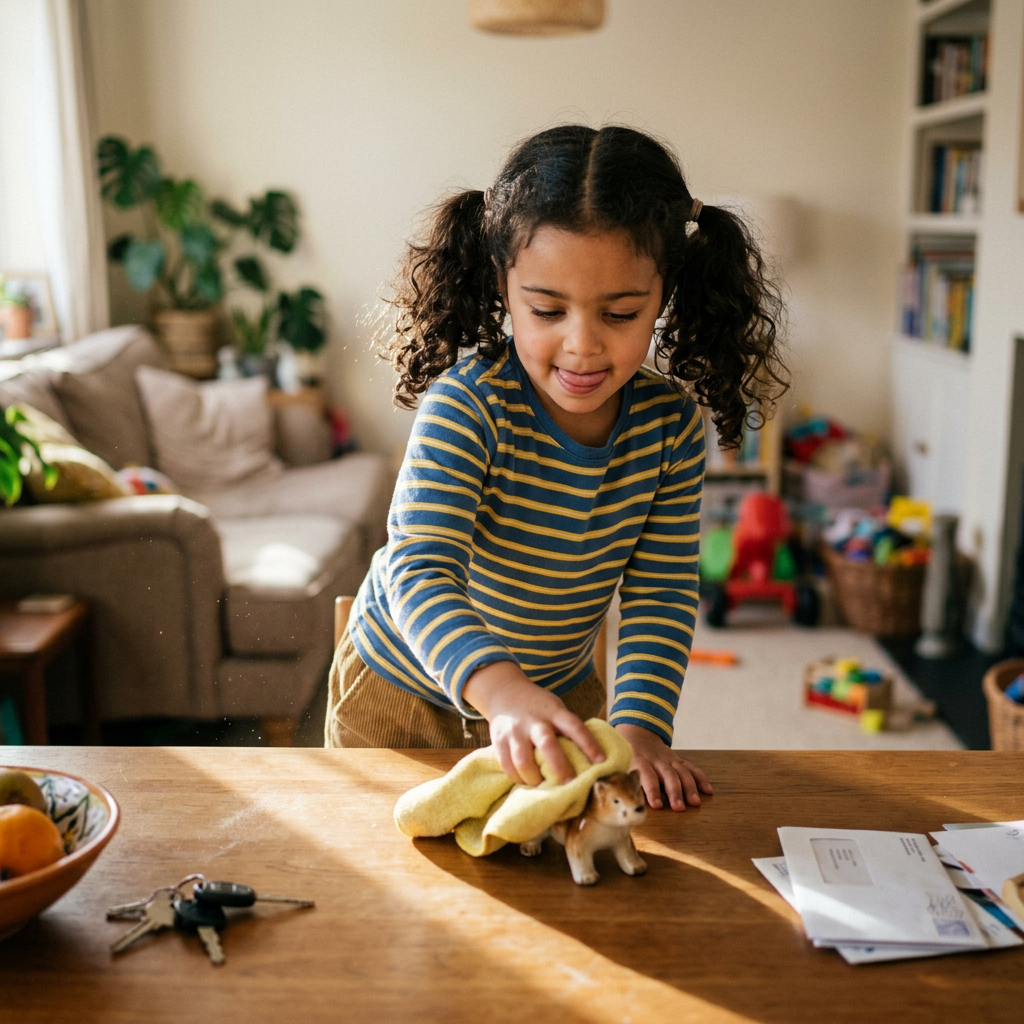
There’s something else that’s different this school year:
Your child is a year older.
That makes back-to-school season a natural opportunity to add a new age-appropriate household responsibility.
You don’t necessarily need a complicated chore chart.
Simply ask:
“What’s one thing you’re old enough to take responsibility for this year?”
For younger children, that might be:
- Putting toys away
- Putting dirty clothes in the hamper
- Making the bed
- Putting shoes away
- Helping set the table
As children get older, responsibilities can grow:
- Emptying wastebaskets
- Sweeping the floor
- Loading or unloading the dishwasher
- Wiping down counters
- Cleaning their bedroom
- Helping with laundry
- Vacuuming a room
There’s research supporting the value of chores beyond simply getting the house clean.
A longitudinal study involving nearly 10,000 children found that doing chores in kindergarten was associated with later measures of self-competence, prosocial behavior and self-efficacy.
Other research has found associations between children’s participation in age-appropriate household chores and executive functions such as working memory and inhibition.
The goal isn’t to turn kids into a cleaning crew.
It’s to teach them that taking care of a home is something everyone who lives there can contribute to.
Teach Kids How to Clean

“Vacuum your room” sounds like a simple instruction to an adult.
A child may hear something completely different.
Do I vacuum around everything?
Do I move the chair?
What do I do with the cord?
Do I vacuum under the bed?
What happens when the vacuum is full?
How do I know when I’m finished?
Instead of assigning a chore and correcting it afterward, spend a few minutes actually teaching the task.
Show them how to pick things up first.
Show them where to start.
Show them how to work their way around the room.
Show them how to get along baseboards and underneath furniture.
Show them how to empty the vacuum or replace the bag when appropriate.
Then let them practice.
Cleaning is a skill.
And like most skills, children get better at it when someone teaches them.
Make the Job Easy Enough to Actually Do
There’s another reason cleaning routines fall apart:
The cleaning equipment makes the job harder than it needs to be.
If your vacuum is extremely heavy, difficult to maneuver, constantly clogging, losing suction or requiring 15 minutes of preparation before you can use it, you’re naturally going to vacuum less often.
The same is true for kids.
If you want children to participate, make sure the tools you’re asking them to use are appropriate for the job and manageable for them.
This doesn’t mean every family needs the newest or most expensive vacuum cleaner.
It means the equipment should fit your home and the way your family actually cleans.
A home with mostly carpeting has different needs than one with primarily hard floors.
A family with multiple shedding pets has different needs than one without pets.
A two-story home may benefit from different equipment than a small apartment.
And someone who wants to quickly vacuum the kitchen every evening may need something different from someone doing a deep whole-house cleaning once a week.
The easier it is to grab the vacuum and clean something, the easier it becomes to turn vacuuming into a routine instead of a project.
Don’t Save Everything for Saturday
One of the easiest traps to fall into is allowing little messes to accumulate all week and then declaring Saturday “cleaning day.”
Suddenly you’ve created a two-hour job nobody wants to do.
Try distributing those jobs throughout the week instead.
A simple routine might look something like this:
Monday
Vacuum bedrooms.
Tuesday
Clean bathrooms.
Wednesday
Vacuum or sweep the main living areas.
Thursday
Catch up on laundry and declutter.
Friday
10-minute reset and enjoy the evening.
Saturday
Tackle one larger cleaning project if needed.
Sunday
Vacuum high-traffic areas and reset the house for the coming school week.
The exact schedule doesn’t matter.
The important part is creating a rhythm that works for your household.
Ten or fifteen minutes here and there can be much easier to maintain than allowing everything to become a weekend project.
Focus on High-Traffic Areas
You don’t have to clean every room equally often.
Some areas simply collect more dirt.
Think about your home’s “traffic pattern.”
Where does everyone enter the house?
Where do shoes come off?
Where does the dog spend most of its time?
Where do the kids eat snacks?
Where does everyone gather in the evening?
Those areas will probably need more frequent attention.
For many families, vacuuming a busy entryway, kitchen, family room or hallway for five minutes several times a week can make a bigger difference than waiting to vacuum the entire house once every week or two.
Make “Resetting” Different From “Cleaning”
This distinction can make household routines much easier.
Resetting means returning the house to its normal state.
Put things away.
Clear the counters.
Pick clothes up.
Put dishes in the dishwasher.
Return shoes and backpacks to their homes.
Cleaning means removing dirt.
Vacuum.
Dust.
Mop.
Scrub.
Wipe.
When everything is already picked up, actual cleaning becomes dramatically easier.
That’s why the 10-minute evening reset can be so valuable.
Instead of spending the first half of your cleaning time moving things around, you’re ready to actually clean.
Don’t Aim for Perfect
The fastest way to abandon a new household routine may be to make it too ambitious.
You don’t need:
A spotless house.
A complicated color-coded chore chart.
Two hours of cleaning every night.
Kids who suddenly love vacuuming.
You need a system your family can realistically repeat.
Maybe that’s five minutes.
Maybe it’s 10.
Maybe everyone has one responsibility.
Maybe you vacuum downstairs on Wednesdays and upstairs on Sundays.
Consistency beats complexity.
If the routine survives busy weeks, soccer practice, homework, late dinners and everything else family life throws at you, you’ve probably found a pretty good system.
A Simple Back-to-School Cleaning Challenge
Want to try it in your house?
Start with these five steps:
- Identify three problem areas.
Where does clutter or dirt accumulate most often? - Give frequently used items a home.
Decide where backpacks, shoes, lunchboxes, papers and sports equipment belong. - Give everyone one responsibility.
Keep it simple and age appropriate. - Create a 10-minute daily reset.
Attach it to something that already happens every day, such as dinner. - Pick two regular vacuuming days.
Start with your highest-traffic areas rather than trying to clean the entire house every time.
Try it for a few weeks.
Then adjust.
A good household routine isn’t the one that looks best on Pinterest.
It’s the one your family will actually keep doing.
A Fresh Start Doesn’t Have to Wait Until January
There’s nothing magical about January 1.
Research on the “Fresh Start Effect” suggests that people can experience renewed motivation around many meaningful transitions — including the beginning of a new semester.
For families, few transitions are more noticeable than the start of another school year.
Everyone’s schedule is changing.
The morning routine is changing.
The evening routine is changing.
The kids are another year older.
So while you’re figuring out bus schedules, packing lunches and getting backpacks ready, consider making one more small change:
Build a cleaning routine that makes taking care of the house part of everyday family life.
Start small. Make it easy. Give everyone a role.
By the time January rolls around, “keep the house cleaner” might not need to be a New Year’s resolution at all.
Need Help Making Vacuuming Easier?

Sometimes a better cleaning routine starts with having the right tool for the job.
At Swanson’s Discount Vacuum, we’ve been helping families find the right vacuum cleaners and cleaning equipment for generations. Different homes, floors, pets and families have different cleaning needs — and we’re happy to help you find something that makes keeping up with your home a little easier.
Whether you’re replacing an old vacuum, looking for something lighter and easier to use or simply need advice about getting better performance from the vacuum you already own, stop in and talk to the team at Swanson’s Discount Vacuum.
A cleaner home doesn’t have to mean spending more time cleaning.
Sometimes it starts with a better routine — and the right equipment to make that routine easier.
Sources & Further Reading
Dai, H., Milkman, K. L., & Riis, J. — “The Fresh Start Effect: Temporal Landmarks Motivate Aspirational Behavior,” Management Science.
The researchers found increases in goal-oriented behavior following temporal landmarks such as the beginning of a week, month, year and semester, birthdays and holidays.
Verplanken, B., & Wood, W. — “Interventions to Break and Create Consumer Habits,” Journal of Public Policy & Marketing.
The researchers discuss how established habits are connected to environmental cues and how naturally occurring changes in circumstances can provide opportunities for behavior change.
White, E. M., et al. — “Associations Between Household Chores and Childhood Self-Competency.”
Using data from 9,971 children, researchers found associations between performing chores in kindergarten and later measures of self-competence, prosocial behavior and self-efficacy.
Tepper, D. L., et al. — “Executive Functions and Household Chores: Does Engagement in Chores Predict Children’s Cognition?”
Research examining the relationship between children’s household chores and executive functions found that self-care and family-care chores significantly predicted working memory and inhibition.


